top of page


The CKW Art Collection at the Museum of Fine Art Houston Makes Historical Works of Art Available to Houstonians
Photograph © The Museum of Fine Arts, Houston and CKW LUXE
Connie Kwan-Wong, the publisher and founder of CKW LUXE Magazine, and her family began establishing an art collection at the Museum of Fine Art Houston (MFAH), in 2018. The purpose of the CKW ART COLLECTION is to make history come alive through important pieces that delineate the skills, aesthetics, and precepts of a culture in a specific place at a specific time. It is their belief that history, in this case art history, has much to teach us about the past, which will open our minds to a greater understanding of where humanity has been and where it is going.

Root-wood Stool from 18th-Century China
The first donation to the collection is an 18th-century root-wood stool that captures the Chinese scholar aesthetic. Stools were fashionable during the Ming and Qing dynasties. The intricate pattern of the piece, depicting a tangle of tree roots, illustrates the artist’s respect for natural materials.

Set of Five 15th-Century Vietnamese Blue-and-White Plates
The second donation is a striking set of five plates reflecting the charming composition and fluid brushwork that are the hallmark of Vietnamese blue-and-white ceramics. Each plate is adorned with fish, birds, and flora native to Vietnam. The set is the museum’s first acquisition of Vietnamese art and the earliest example of blue-and-white ceramics in its Asian collection. In the 15th century, some of the vessels shipping Vietnamese ceramics to other parts of the world were lost at sea. Three of the plates in this set have been marked as having been recovered from the Hội An shipwreck, and are, therefore, important dated examples of mid-to-late 15-century artifacts from the Red River delta. The complete set was assembled by eminent nuclear physicist, and esteemed collector, John R. Menke. His collection of Vietnamese ceramics has been on long-term loan to the Johnson Museum of Art at Cornell University.

Vietnamese Silver Phoenix Guomsword from the 19th Century
The third donation is a 19th-century Vietnamese silver phoenix guomsword. The intricately carved piece features a winged falcon hand guard, dragon’s head handle, and knuckle bow lion’s head as well as numerous other elaborate designs. The fine workmanship suggests the sword was made for a high-ranking official and may have been made for a special occasion due to the unusual phoenix design, which makes it unique.

Pair of Six-panel Japanese Screens Painted by Kajino Genzan in the 1920s
The fourth donation, which is currently on loan to MFAH, will be a pair of six-panel Japanese screens (byōbu) in Japanese ink (sumi) and gold paint (kindei) on paper, painted by Kajino Genzan in the 1920s. Born in Japan during the Meiji period, Genzan was influenced by the artistic and cultural changes of the time, which saw a blending of Western and Eastern artistic practices. While his works often focused on classical Japanese subjects, his depictions of birds and nature set him apart. This screen is a prime example of his work, elegantly portraying a male peafowl on the right and a female on the left.

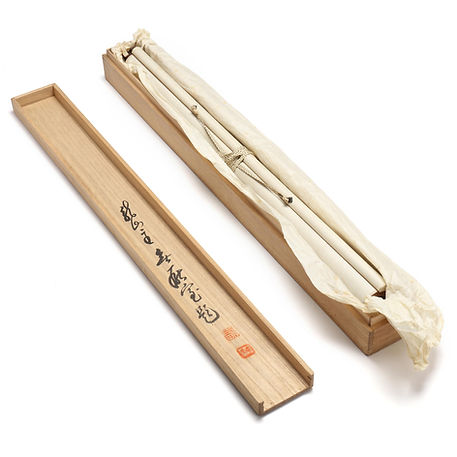
Japanese Hanging Scroll by Nakahara Nantenbō (1839 to 1925) Depicting Daruma as a Gourd
The fifth donation, which is also currently on loan to MFAH, will be is a Japanese hanging scroll painted in ink on paper by Nakahara Nantenbō, a Japanese Zen master, who lived from 1839 to 1925. It is a notable example of Nantenbō’s depiction of Bodhidharma, an Indian monk credited with bringing Zen Buddhist teachings to China in the 500s, as a gourd. In Japan, Bodhidharma became a revered figure in Zen Buddhism and was known as Daruma. Nantenbō bridged the gap between older forms of Zen Buddhist art and its continuation into the 20th century. The subject also references one of his personal seals, which can be seen on the work. The inscription likely alludes to Buddha nature, using the dried gourd as a metaphor for life, death, and aging.
Historical works of art teach us about cultures at a specific place and time in their development. This knowledge is intrinsic to understanding their traditions, cultural values, skill levels, and aesthetics. It teaches us about the past and helps us see the journey that has led to the present. The Wong family and MFAH understand that and are delighted, through the CKW ART COLLECTION, to share precious pieces of art with Houstonians that do just that.
bottom of page