
Rebel Queen: Susan Polgar’s Harrowing Autobiography
Personifies the Power of the Human Spirit and the Promise of the Game of Chess

“Susan Polgar’s journey from the depths of Cold War Hungary to the highest reaches of professional chess is as riveting as it is inspiring . . . This is no mere memoir. Rebel Queen is the origin story of a real-life superhero.” —Gal Gadot
For Susan Polgar, who became one of the most prominent women in the history of chess, growing up in Hungary during the Cold War meant living within the constraints of an authoritarian regime and a sexist society. However, these were barriers that, instead of being confined by, she fought against and ultimately freed herself from. The story of Polgar’s rebellion against these obstacles is a fascinating one, which she tells with inspiring clarity in her autobiography, Rebel Queen: The Cold War, Misogyny, and the Making of a Grandmaster.
Polgar won her first tournament at the age of four at the Budapest Championship for girls 11 and under. Her score was a perfect 10-0, and she accomplished it while sitting on a stack of telephone books so she could see the board. The skill and tenacity she exhibited at that first tournament served her again and again as she faced obstacles not only in the male-dominated world of chess, but in all aspects of her life. Being female and Jewish, Polgar met with sexism, anti-Semitism, and government hostility.
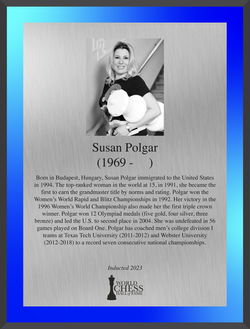
Despite the inequities, Polgar became the first woman to qualify for the men’s World Chess Championship cycle when she was only a teenager. At the age of 21, she became the first woman in the world to earn the men’s Grandmaster title, which is the highest designation in chess. Making history again, she later became the first chess player of either sex to achieve “triple crown.” This means Polgar held world championship titles in all three chess time formats: blitz, rapid, and classical. On top of all of this, she continues to be the only player to earn all six of the world’s greatest chess crowns: triple crown, world #1 ranking, and individual and team Olympiad gold.
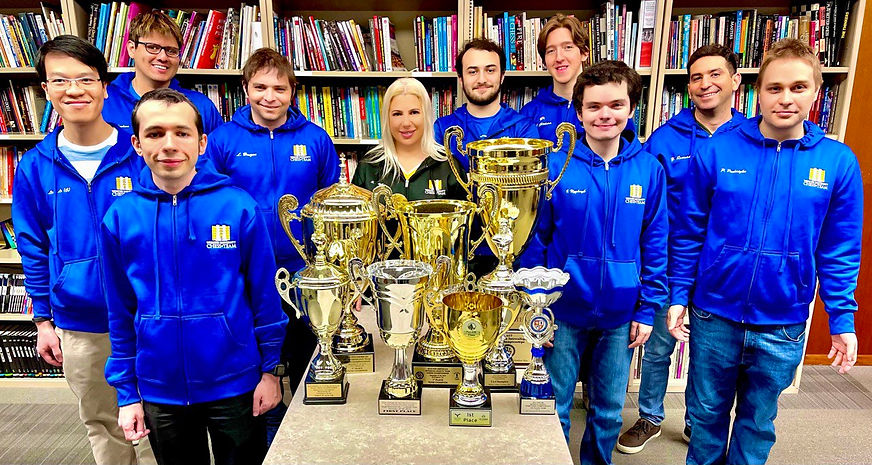
Polgar is now an American citizen, having left Hungary to begin a new life in the United States. After retiring as a player, she became the only female Division 1 college coach in the country. She built two separate college chess dynasties from scratch: one at Texas Tech in Lubbock and one at Webster University in St. Louis. She led both to more national titles, world championships, major titles, and Olympiad medals than all other college chess teams combined. She remains the Director Emeritus of, and advisor to, the Susan Polgar Institute for Chess Excellence (SPICE) at Webster University.


In Rebel Queen, Polgar introduces us to herself as a small child discovering chess for the first time. Coming upon a chess set quite by accident at the age of four, Polgar was encouraged to play by her father, László, who became integral to her advancement in the game. With Polgar and her sisters, he set out on an educational experiment based on the theory that “geniuses are made not born.” With focused early training, she was able to realize extraordinary success, even when the odds seemed to be against her.
As described in the book, there were many factors working against Polgar. Misogyny and sexism were two of them. In communist Hungary at that time, it was believed that women were incapable of excellence in chess. When she was only five, and she wanted very much to compete in the Budapest Championship, she was not allowed to because she was a girl. It was to be the first of many such experiences. Rather than discourage Polgar, however, these combined instances strengthened her resolve not to give in to the chess authorities and play only against girls and women.
 |  |  |
|---|---|---|
 |  |  |
One of the book’s most powerful take-aways is the importance of perseverance to finally gain empowerment. Despite the serious challenges Polgar faced, which she bravely recounts throughout her book, the reader never perceives her as a victim. Instead, they discover a brilliant chess player who has the courage to show the world who she really is. For young women with dreams, whether they are to play chess or to accomplish something else, Polgar’s book serves as a beacon to be true to themselves and to pursue their dreams no matter the odds.
The book’s major themes: overcoming misogyny and sexism, perseverance and empowerment, the power of education and belief, consistent hard work resulting in success, seeing failure as a motivator and not a drawback, and discovering what we are most passionate about pertain to all of us in our lives and in the fields we choose to work in. Because of them, and the way we identify with them, Polgar’s journey reflects our own even if we aren’t chess Grandmasters. Her dedication to learning, her steady struggle for self-empowerment, her strict work ethic resulting in her success, her ability to use setbacks to her advantage, and her ultimately successful battle against misogyny and sexism to continue in the field she loved assure us we are not alone in our experiences and offer us hope.
Along with becoming a positive example for girls and women comes the weight of what that means, which Polgar also explores in the book. However, she has not shied away from the responsibility. Instead, she has embraced it by talking to girls and women about her experiences and through The Susan Polgar Foundation, Inc., a nonprofit 501 (c) (3) corporation supported by charitable donations. Its mission is to promote chess, with all its educational, social, and competitive benefits throughout the United States, for young people of all ages, especially girls. Polgar believes the benefits of chess include developing decision-making, critical thinking, logical thinking, evaluating, planning, problem-solving, and persevering; improving concentration, memory, intuition and self-control; and promoting independence, imagination and creativity.
With the foundation, numerous events, such as the Susan Polgar Foundation Girls’ Invitational, SPF National Open Championship for Girls and Boys, SPF World Open Championship for Girls and Boys, Susan Polgar All-Star Girl’s Chess Team, and the “Get Smart! Play Chess!” series, have been born. The foundation also supports elite annual events such as the SPICE Cup and the SPICE Spring Invitational. With the future in mind, it is Polgar’s hope that she can raise funds for an endowment for the foundation, so its programs can continue on in perpetuity to benefit generations to come. In 2025, Polgar announced the Rebel Queen award, which will be presented to outstanding women who demonstrate qualities of leadership, inclusion, and community impact while overcoming significant barriers.
Polgar is focused on inspiring and empowering the upcoming generation. Although her emphasis is on girls and women, she aspires to influencing anyone who is being told they are not capable of doing something. She wants them to understand that once they have found their passion, with hard work, anything is possible.
Against all odds, Susan Polgar battled impediment after impediment and broke chess’ long-standing gender barrier. No wonder Gal Gadot, Wonder Woman herself, calls Polgar’s memoir, “the origin story of a real-life superhero.” Rebel Queen is a story of courage, persistence, and strength that stands as a testament to the power, and love of, the game of chess.
CKW LUXE is pleased to announce that it will be partnering with Girl Chess Power and Beyond to host CKW LUXE & Girl Chess Power and Beyond Featuring Chess Grandmaster Susan Polgar and Her Global Impact.